
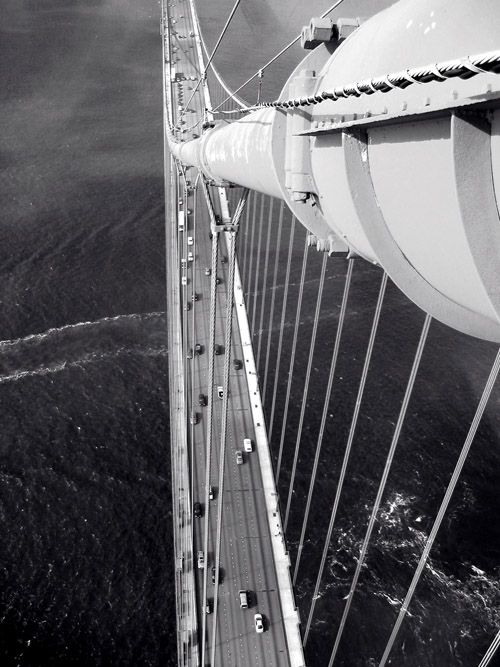
Golden Gate

From WikiArquitectura - Buildings of the World
Jump to: navigation, search
Golden Gate
Golden Gate Golden.jpg
Engineer: Joseph B. Strauss
Second Engineer: Charles Ellis
Designer: Leon Moissieff
Year of construction: 1933 - 1937
Ubication: San Francisco, USA


Contents

Introduction

The entrance to the Bay of San Francisco was named "Chrysopylae", or "Golden Gate" by the explorer John Charles Fremont in 1846 because he felt that the Grand Entry will be advantageous to trade. Before the construction of the Golden Gate bridge, people used ferries traveling between San Francisco and Marin to travel or to carry spring water from Sausalito to San Francisco.

In 1919 the visionary engineer Joseph B. Strauss came to San Francisco to inspect the site. He was convinced he could build a bridge over the Golden Gate, on January 5, in 1933 work began and lasted four years and a half.

One of the most recognizable structures in the world, the Golden Gate Bridge was also at the time of its completion in 1937 the longest suspension bridge, and remained for 27 years so. Between its two large steel towers go 1280 meters of open waters.

The bridge became a success since its construction, in 1971 the Golden Gate bridge covered their $ 75 million just for the cost of a toll collection to visitors on their way to south San Francisco. In the last seven decades, it has endured numerous earthquakes, including the devastating 1989 of 7.1 on the Richter scale. In fact, the bridge has been closed only three times in its history due to high winds.

Joseph Strauss is credited as the visionary leader and engineer of this project. However, the engineer Charles Ellis and designer Leon Moissieff played an important role in the success of this iconic intersection. Provided only with a slide rule and an adding machine, with its operations solved the problems of compression and tension encountered by the project.


•Technical sheet


Height: 75 meters above water

Total length of Bridge including approaches: 1.7 miles = 8981 ft = 2737 m

Width of Bridge: 90 ft = 27 m

Weight: 80,470 tons

Workforce: Unknown, but 11 workers died during construction.

Time scale of the project: 4 years.

Material: Steel

Capacity: up to 2002, 1700 million vehicles had crossed the bridge.

Situation

The bridge was built in the North San Francisco Bay and connects the city with Marin County, California, United States


Concetp

In 1868 there was already a regular ferry service between San Francisco and Marin County, but the speculators were who believe in the upgrade of their properties if they have a transportation means more practical and effective

Structure

Suspension Bridge

This type of bridge has cables suspended between towers, plus vertical suspender cables that carry the weight of the deck below, upon which traffic crosses. This arrangement allows the deck to be level or to arc upward for additional clearance. Like other suspension bridge types, this type often is constructed without falsework.

Structure is balanced because the weight on each side of the stack is offset by the weight of the other side. Imagine two scales (with two dishes each) to put next each other in line. On both scales put half brick in the end dish, and a whole brick on dishes that would be in the middle, but so that one half of the whole brick resting on the dishe of a balance and half on the other one.

Main Tower Stats

The Golden Gate is suspended on two towers of 227 meters height above the water level. There are beacons lights at the top of the towers to warn ships and aircraft of the existence of the bridge.

Golden Gate Towers

• Technical sheet

The Golden Gate Bridge has two main towers that support the two main cables.

Hight of tower above water: 746 ft = 227 m

Hight of tower above roadway: 500 ft = 152 m

Tower base dimension (each leg): 33 x 54 ft = 10 x 16 m

Load on each tower from main cables: 61,500 tons = 56,000,000 kg

Weight of both main towers: 44,000 tons = 40,200,000 kg

Transverse deflection of towers: 12.5 inches = 0.32 m

Flexión longitudinal de torres: 0,56 m y 0,46 m

Longitudinal deflection of towers: shoreward: 22 in = 0.56 m and channelward: 18 = 0,46 m

The south tower foundation depth below mean low water is: 110 ft = 34m

To build south tower pier to support the south tower, construction workers pumped 9.41 million gallons or 35.6 million liters of water out of the fender that was constructed first. Street

It has six lanes for vehicular traffic, with an approximate width of 27 meters and a depth of 7.6 m.


• Deformation bridge load capacity:


The maximum deviation of the cross in the middle include: 8.4 meters

The maximum downward deflection at the middle include: 3.3 m

Maximum upward deviation in the middle includes: 1.77 m

Load capacity per linear foot: 1814.4 kg

Cables

Hung between two elegant towers, the two main cables of the bridge weighing 11,000 tons each and are made up of 25,000 individual wires, and are secured at either end in giant anchorages. In addition to sustaining the street suspended cables transmit compression on the towers of the bridge and tie at each end of the building and have a length of 2332 meters.


•Technical sheet

Golden gate 2.jpg

Diameter of one main cable including the exterior wrapping: 36 3/8 in. = 0.92 m

Length of one main cable: 7,650 ft = 2,332 m

Total length of galvanized steel wire used in both main cables: 80,000 mi = 129,000 km

Number of galvanized steel wires in one main cable that are 0.192 inches in diameter: 27,572

Number of bundles or strands of galvanized steel wire in one main cable: 61

Weight of both main cables, suspender cables and accessories: 24,500 tons = 22,200,000 kg

The galvanized steel wire comprising each main cable was laid by spinning the wire using a loom-type shuttle that moved back and forth as it laid the wire in place to form the cables. The spinning of the main cable wires was completed in 6 months and 9 days.

Materials

Both, beams and cables are made of steel and each tower have been used approximately 600,000 rivets.

The anchorages of the towers are made of concrete.

Rehabilitation

Over the years, salt and moisture from fog and the ocean has caused the cover of the road began to show signs of deterioration. In response, the largest engineering project since the construction of the bridge was carried out with the replacement of the original deck with lightweight concrete, steel orthotropic stronger asphalt and covered with epoxy.

The project, which took place between 1982 and 1986, dropped 12,300 tons of the total weight of the bridge. It has also expanded the width of the road crosses, extending between 60 and 62 feet, reducing the width of sidewalks.

Videos

YouTube : bad video ID !

YouTube : bad video ID !

Drawings

Photos

Constrution

At present


[[Category:]] [[Category:]] [[Category:]] [[Category:]] [[Category:]]

Personal tools
Namespaces

Variants
Actions
site
utilities
Toolbox